 English
How Mobile Application Development Services Improve Customer Experience

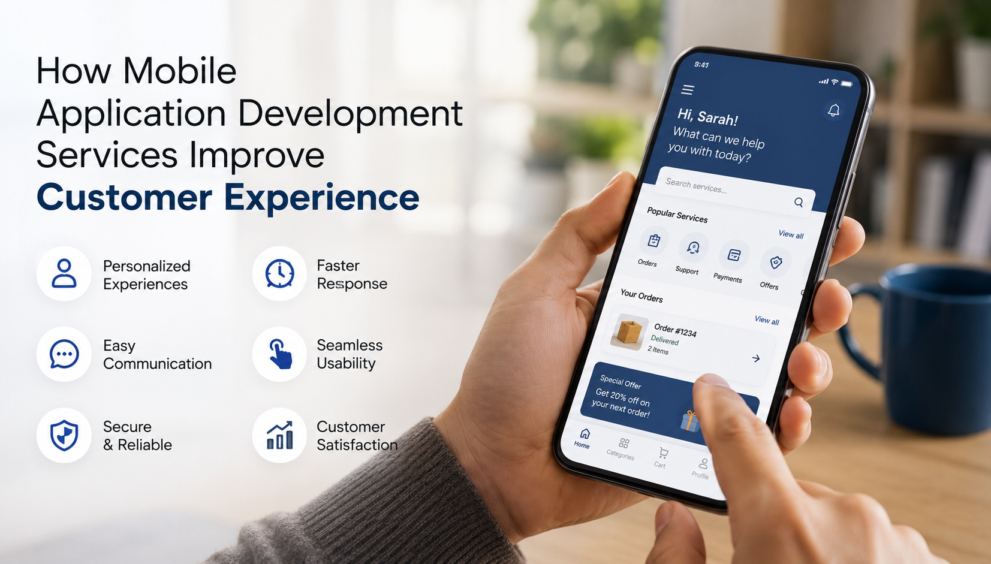
Picture the last time you got frustrated with a brand. Chances are it wasn’t the product itself. It was the friction around it a clunky checkout, a support line that put you on hold for twenty minutes, or a website that made you pinch-zoom just to read a menu. Customers don’t leave brands because the core offering is bad. They leave because getting to that offering feels like work.
This is exactly why so many companies are turning to Mobile Application Development Services to close that gap. A well-built app doesn’t just put a business in someone’s pocket it removes the friction that quietly drives people toward competitors. And in a market where the average person checks their phone dozens of times a day, that pocket is prime real estate.
Let’s talk about what actually happens when a business gets this right and why customer experience, not just app functionality, has become the real battleground.
Speed Is the New Storefront
Nobody waits anymore. Studies on mobile behavior consistently show that users abandon an app if it takes more than a few seconds to load. That’s not impatience for its own sake it’s a learned expectation shaped by years of fast, responsive digital products. If your app lags, stutters, or crashes, the customer doesn’t blame their phone. They blame you.
A properly engineered app is built with performance as a first-class requirement, not an afterthought bolted on before launch. That means optimized code, efficient data handling, and interfaces that respond the instant a finger taps the screen. When speed becomes invisible, customers stop noticing the app and start noticing the experience which is exactly the point.
Personalization That Actually Feels Personal
Generic experiences are forgettable. Apps that remember what a customer likes, what they’ve bought before, and what they tend to search for create something websites rarely can: a relationship that deepens over time.
Think about how a food delivery app resurfaces your usual order, or how a retail app nudges you toward a size you’ve bought before. This isn’t magic it’s thoughtful use of behavioral data paired with smart design. Done well, personalization makes customers feel understood rather than tracked. Done poorly, it feels invasive. The line between the two is where good app development earns its value.
Reducing Friction at Every Single Step
Every extra tap is a chance for someone to give up. Every confusing menu is a chance for someone to close the app and never open it again. Reducing friction is less about flashy features and more about ruthless simplicity fewer steps to checkout, clearer navigation, forms that auto-fill instead of demanding the same information twice.
This is where user experience design and technical development have to work as one team, not two separate departments. A gorgeous interface built on a slow backend fails the customer just as badly as an ugly one. The businesses that win are the ones treating friction reduction as an ongoing discipline, not a one-time redesign.
Always-On Availability Changes Customer Expectations
A physical store closes at night. An app never does. This always-on nature has reshaped what customers expect from every brand they interact with instant answers, real-time order tracking, and support that doesn’t require waiting for business hours.
Features like push notifications, in-app chat, and live status updates aren’t add-ons anymore; they’re baseline expectations. When a customer can track a delivery in real time or get a question answered by a chatbot at 2 a.m., trust builds quietly in the background. That trust is hard to build any other way, and even harder to replace once a competitor offers it and you don’t.
Data Feedback Loops That Improve the Experience Over Time
One underrated advantage of apps over other channels is the sheer amount of behavioral insight they generate. Every scroll, tap, and drop-off point tells a story about where customers are struggling or losing interest. Businesses that actually use this data rather than letting it sit in a dashboard nobody checks can fix problems before they turn into churn.
This creates a loop: the app collects signals, the team acts on them, the experience improves, and customer satisfaction rises as a result. Over months and years, this compounding effect separates brands that feel like they’re constantly evolving from ones that feel stuck in 2015.
Trust Signals Customers Don’t Consciously Notice But Feel
Security might be the least glamorous part of this conversation, but it might matter the most. A single data breach or awkward payment failure can undo years of goodwill. Encrypted transactions, secure login options like biometric authentication, and transparent privacy practices all quietly reassure customers that they’re safe.
Most people won’t articulate “I trust this app because of its security architecture.” But they’ll feel the absence of trust immediately if something goes wrong a payment that fails twice, a login that behaves strangely, a permission request that feels off. Getting this right isn’t just a technical checkbox; it’s part of the emotional experience of using the product.
Why This All Adds Up to Loyalty
Here’s the part that matters for the bottom line: customer experience and customer retention aren’t separate metrics they’re the same story told twice. A frictionless, fast, personalized, secure app doesn’t just make someone’s day slightly easier. It makes them more likely to come back, spend more, and recommend the brand to someone else without being asked.
Businesses investing in strong app development aren’t chasing a trend. They’re recognizing that the app has become the front door, the sales floor, the support desk, and the loyalty program all at once. Getting that front door right changes everything downstream.
Final Thought
Customer experience used to be shaped mostly by physical interactions a helpful salesperson, a well-organized store, a clean checkout counter. Today, that experience lives largely inside a screen. The brands winning right now aren’t necessarily the ones with the biggest budgets. They’re the ones who understood early that a smooth, thoughtful mobile experience isn’t a feature it’s the relationship itself.
If your app still feels like an afterthought, that’s probably how your customers feel too.