
 English


How Brick Making in India Changed in Forty Years

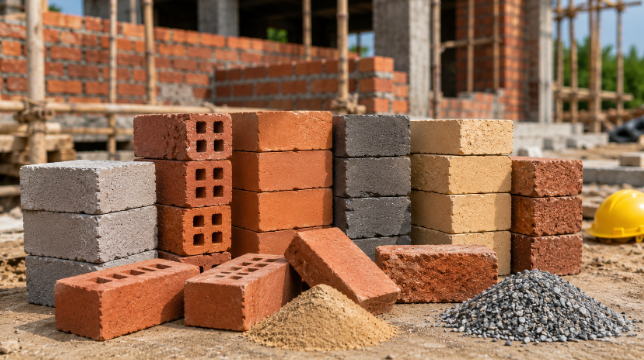
Drive out of any Indian city on a winter morning and you can still spot the tall chimneys on the horizon, smoke drifting sideways.
Some of those kilns have not changed since the 1970s. Others, sitting a few kilometres away, are running tunnel kilns with temperature sensors and automated cutting lines.
Both are part of the same industry. That gap is the whole story of the last four decades.
Where it started
For most of the twentieth century, brick making in this country was a seasonal, weather-dependent, largely manual business.
Clay was dug by hand. Bricks were moulded by hand, laid out in the sun to dry, then stacked into a Bull’s Trench kiln and fired with coal. When the monsoon came, production stopped. When the wind changed direction, the firing changed with it.
The result was a product that varied enormously. Bricks from the outer rows of a kiln came out underburnt and soft. The ones near the centre came out overburnt and warped. Somewhere in the middle was the good stock, and buyers sorted through the pile hoping to find it.
Nobody was doing this badly on purpose. The process simply had no way to control itself.
What actually changed
Three things, mostly.
Extrusion replaced hand moulding. Clay is now mixed to a controlled moisture content and forced through a die under pressure, then cut by wire into equal pieces. Density goes up. Size stops varying.
Tunnel and zigzag kilns replaced open firing. Instead of the fire moving around the bricks, the bricks move through zones of controlled temperature. Firing becomes repeatable rather than lucky.
Testing became normal. Compressive strength and water absorption figures are now expected on serious orders. Twenty years ago, asking for a test report on a brick would have got you a strange look.
Put together, these shifts turned the brick manufacturing industry in India from a craft into a production process. Not everywhere. But in enough places to change what buyers expect.
The environmental push nobody could ignore
Regulation did a lot of the pushing.
Traditional fixed-chimney kilns burn a great deal of coal for the output they produce. As air quality became a policy priority, particularly across the northern plains, state pollution control boards began mandating cleaner technologies. Zigzag firing became the baseline in many states, and older kilns either upgraded or shut.
Fly ash entered the picture too, as a partial replacement for clay in some products. Topsoil use came under scrutiny. Waste heat recovery started appearing in larger plants.
None of this was voluntary at first. Much of it has turned out to be commercially sensible anyway — better firing efficiency means lower fuel cost per thousand bricks, and fuel is the largest variable expense in brick making in India.
What buyers expect now
The demand side changed just as much as the supply side.
Architects started specifying exposed brick façades, which meant the face of the brick suddenly mattered. Wirecut finishes, jali screens, special shapes, roof tiles in matched colours — none of these were mainstream categories in 1990.
Builders working to tight schedules started valuing dimensional consistency over everything, because a wall that goes up faster with less mortar correction saves labour on every single square metre.
And homeowners, with the internet in their pocket, began asking questions their fathers never asked. Strength figures. Absorption percentages. Whether the supplier actually owns a kiln.
Manufacturers who invested early adapted to all of it. Mahaluxmi Bricks has been running since 1982 from Panchkula and now releases ten to fifteen new products a year across wirecut, jali, special shapes, and roof tile ranges — which is a fair snapshot of how far the category has widened.
The part that has not changed
For all of it, one thing stayed exactly where it was.
Clay is still clay. It still has to be dug, blended, shaped, dried, and fired, and no amount of automation removes a single one of those steps. A brick still takes roughly the same number of hours to become a brick as it did in 1982.
What technology changed was the failure rate, not the recipe.
That is worth remembering when someone sells you a brick as a radically new material. It isn’t one. It is one of the oldest building products on earth, made slightly more reliably than it used to be.
Where it goes next
Consolidation, most likely. Small seasonal kilns face rising fuel costs, tighter environmental rules, and a labour pool that is shrinking as workers move to other sectors.
Mechanised plants absorb that pressure better. They also produce the products that current design demand actually wants.
The brick manufacturing industry will not stop being fragmented overnight — it is far too large and too regional for that. But the direction is clear enough. Controlled firing, tested output, consistent dimensions, and a much wider product range than a plain red rectangle.
The thing worth remembering
Forty years ago, buying bricks meant sorting through a pile and hoping.
Today it means asking for a report and getting one. That is a bigger change than it sounds, and it happened without most people noticing.