
 English

AI-Powered Mobile App Development for Smarter Businesses

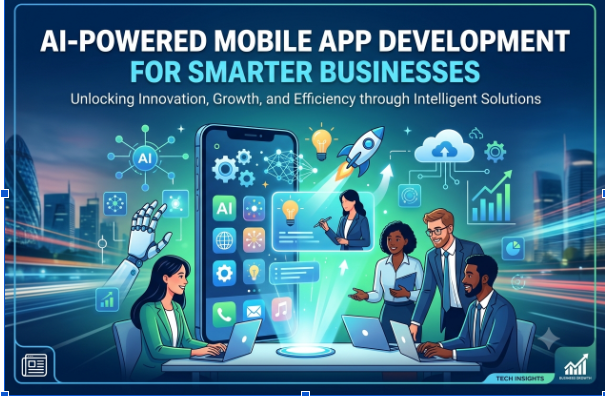
A few years ago, adding “AI” to an app felt like a gimmick — a chatbot bolted onto a checkout page, or a recommendation widget nobody clicked. That’s changed. Today, artificial intelligence is quietly becoming the backbone of how businesses build and run their apps, and it’s reshaping mobile app development from the inside out.
If you run a business and you’re wondering whether this shift is worth paying attention to, the short answer is yes. Here’s why, and what it actually looks like in practice.
Why AI Is Changing the Game
Traditional mobile app development follows a fairly predictable path: gather requirements, design screens, write code, test, ship, repeat. It works, but it’s slow, and it puts the burden of every decision on human developers. AI changes that equation. Machine learning models can now predict what a user wants before they ask for it, automate testing that used to eat up weeks, and even help write and debug code.
For businesses, this isn’t just a technical upgrade — it’s a competitive one. Companies that bring AI into this process are shipping features faster, catching bugs earlier, and building apps that genuinely adapt to the people using them.
Smarter Personalization, Not Just More Data
Every app collects data, but most of it goes unused. AI is what turns that raw data into something useful. A retail app can learn a shopper’s preferences and reorder its own layout around them. A fitness app can notice when someone’s motivation is dipping and adjust its nudges accordingly. None of this requires a human to manually configure rules for every scenario — the model figures it out from behavior.
This is one of the clearest wins in modern mobile app development: personalization that used to take entire product teams can now be handled by well-trained models running quietly in the background.
Faster, Cheaper Builds
AI coding assistants have become genuinely useful collaborators rather than novelties. They can generate boilerplate, suggest fixes, and flag security issues before a human ever reviews the code. Automated testing tools powered by AI can simulate thousands of user interactions in the time it would take a QA team to test a handful manually.
For a small business, this matters enormously. Mobile app development used to require a sizable in-house team or a costly agency retainer just to keep pace with updates. Now, a lean team can move at a speed that once required three times the headcount, because AI is absorbing the repetitive work.
Smarter Customer Support, Built In
Conversational AI has matured well past the scripted chatbots of a decade ago. Modern assistants embedded in apps can understand context, handle multi-step requests, and hand off to a human only when it truly makes sense. This isn’t just a support-cost play — it changes how customers experience the product itself.
Businesses that treat AI-driven support as a core part of their app strategy, rather than an afterthought, tend to see stronger retention. Users stay longer when problems get solved in-app, in seconds, instead of through a support ticket that sits unanswered for a day.
Predictive Insights for Better Decisions
Beyond the user-facing side, AI is also changing how businesses make decisions about their apps. Predictive analytics can flag which users are likely to churn, which features are gaining traction, and where the app is quietly losing people. Instead of waiting for a quarterly report, teams can act on signals as they emerge.
This kind of foresight used to be reserved for companies with large data science teams. Now it’s becoming a standard part of AI-powered mobile app development, available to businesses of almost any size.
Getting Started Without Overcomplicating It
None of this means every business needs to build custom machine learning models from scratch.Most of the value comes from using existing AI services thoughtfully — a recommendation engine here, a smart search feature there, an AI assistant woven into support. For businesses exploring multi-service app development, AI can also help improve personalized recommendations, intelligent search, automated customer support, and user engagement. The businesses that get the most out of this shift are the ones who start small, measure what actually helps their users, and build from there.
Final Thoughts
AI isn’t replacing the fundamentals of good app design — it’s amplifying them. The businesses seeing real results aren’t the ones chasing every new AI trend; they’re the ones using it to solve genuine problems for their users, whether that’s faster support, smarter personalization, or a development process that doesn’t grind to a halt every time requirements change.
If you’re planning your next app or rethinking an existing one, it’s worth asking where AI can genuinely make things smarter rather than just newer. Approached that way, AI-powered mobile app development stops being a buzzword and starts being a real advantage — one that helps businesses build apps that think a little more like the people who use them.