 English
The C-Arm Test: How to Judge an OT Table Manufacturer Before the Order Goes Out

Forty minutes into a spine case, the C-arm needs to come in.
And the table won’t clear the base.
The hospital bought that table two years earlier because it looked excellent in a brochure. Nobody had asked the one question that mattered, which was whether a C-arm could actually run the length of it. Now a surgeon is standing there with a sterile field and a problem nobody can fix in the room.
That single moment tells you more about an OT table manufacturer than any specification sheet will.
What the brochure never shows you
Almost everything separating a good operation table manufacturer from a poor one happens where buyers never look. Inside the column. In the weld quality along the base. In whether the actuator was genuinely rated for a 250 kg patient or whether the lab test quietly assumed 120 and everybody moved on.
You can’t see any of that from a photograph. You can see it in year three, when a table starts drifting under load, but by then the money’s gone.
So the job before purchase is to find proxies — things you can check that correlate with things you can’t.
Five questions worth asking
Ask for the CDSCO manufacturing licence itself, not a photograph of a certificate. Ask for ISO 13485 specifically, because ISO 9001 on its own doesn’t cover medical devices and plenty of suppliers hope you won’t notice the difference.
Ask how many installations they have in your own state. Not nationally — your state, where an engineer would actually have to drive.
Ask whether spares are still available for a model they sold ten years ago. That one question filters out most trading houses posing as operation theatre table manufacturers in India, because a genuine factory keeps drawings and a reseller keeps a catalogue.
And ask to visit the plant. Real surgical table manufacturers say yes immediately. It’s remarkable how reliable that test is.
Drive systems, in one paragraph each
A hydraulic table runs off a foot pump, doesn’t care what the mains is doing, and has very little inside it that can fail. For nursing homes and day-care centres running mostly general surgery, a serious hydraulic OT table manufacturer will often steer you here — not because it’s cheaper, but because it’s the correct machine for that case mix.
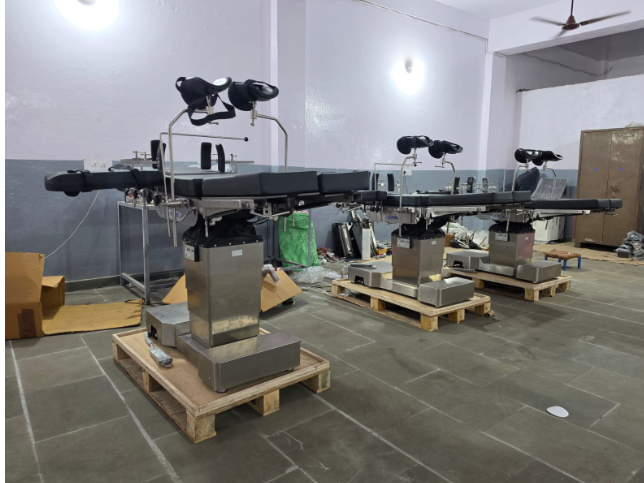
An electric table replaces the pump with motorised actuators and a handheld remote. Height, trendelenburg, lateral tilt, back and leg sections, all adjusted from a keypad without the circulating nurse breaking position. Any competent electric OT table manufacturer builds in battery backup and a manual override as standard, because power supply in Indian hospitals is not consistently polite.
Electro hydraulic is the hybrid — electronic control on top, hydraulic lift underneath — and honestly it’s where most modern multi-speciality theatres end up. You get the load-bearing stability of hydraulics and the precision of electronic positioning in one column.
Which is right for you depends on your case mix. Not your budget line. Those are different questions and mixing them up is how the wrong table ends up in the room.
Attachments decide what you can actually operate on
This is the part almost everyone skips, and it costs them later.
Shoulder supports, arm boards, anaesthesia screen, kidney bridge, leg holders, spinal frame, orthopaedic traction — each one unlocks a procedure. Buy the table bare and you’ll find out about six months in that the gynaec team can’t do the list they were promised. Then you’re negotiating a second purchase order for parts that should have been specified on day one.
Ventek’s Amaze 5001 handles some of this with interchangeable head and leg sections, so one table covers more positions without a second buy. Their full range and the certification detail sit on the OT table manufacturer page if you want to compare configurations properly.
The unglamorous specifications
Rust-proof medical grade SS 304. Anti-bacterial coating in line with NABH guidelines. A 13 mm methoxy methyl melamine tabletop giving C-arm filtration of ≤1mmAL with unrestricted access along the table length. Patient load from 50 kg to 250 kg without mechanical shake.
Ventek runs every unit through a 48-hour non-stop failure check plus temperature and voltage fluctuation testing before it ships.
Boring list. It’s also the entire difference between a table still working in year fifteen and one that starts drifting in year three.
One line from a procurement head
During an installation last year, a procurement head said something worth repeating: the table you cannot get serviced is the table you’ll end up buying twice.
He wasn’t being clever. He’d done it once already.
Before you sign
Confirm C-arm clearance for the equipment you actually own. Get the CDSCO licence and ISO 13485 in writing. Check the spare-parts commitment in years. Find out where the nearest service engineer is based. Specify every attachment now rather than later.
Ventek Care Pvt. Ltd. has been building lights and tables out of its New Delhi facility for eighteen-plus years, with 30,000+ installations, 1,150+ distributors and reach into 27 countries, plus CDSCO registration, US FDA listing and GeM approved OEM status.
Send them your case mix and room dimensions before you finalise the spec. The right table is rarely the one that photographs best.