
 English



Understanding the Loan Repayment Journey: How Each EMI Payment Splits into Interest and Principal Over Time

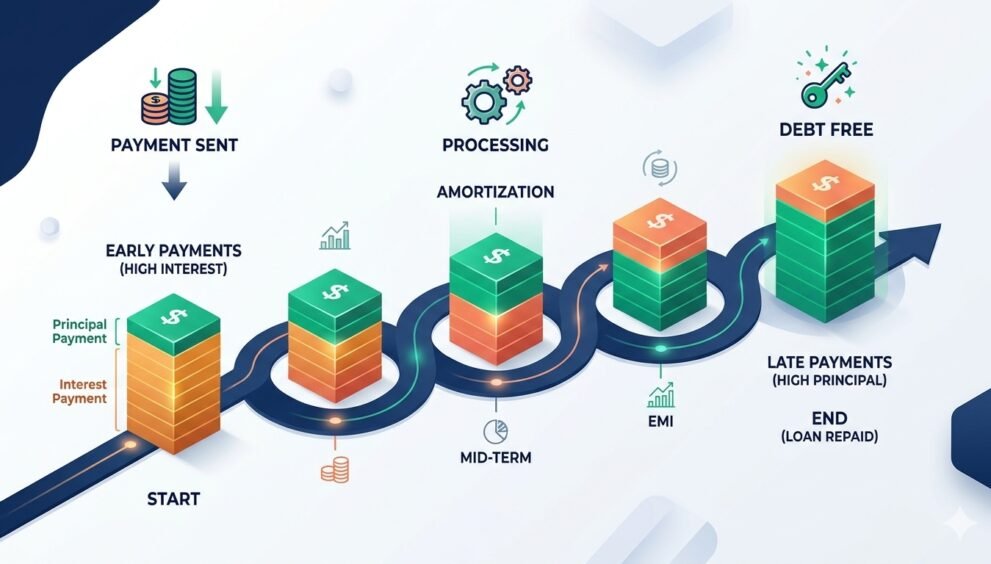
Every individual who has taken a loan is familiar with the term EMI, or Equated Monthly Installment. This structure is fundamental to loan repayment, breaking down what could be an overwhelming financial obligation into manageable monthly payments. A crucial aspect of this payment structure is understanding how each EMI payment is divided between the interest and the principal amount of the loan over time. This knowledge can help borrowers better manage their finances, making informed decisions throughout their borrowing journey.
How Loan Repayment Works Over Time
When an individual takes a loan, they enter into an agreement to repay the borrowed amount plus interest over a specified period. The EMI is calculated based on the loan amount, the interest rate, and the tenure of the loan. Each month, a portion of the EMI goes towards paying off interest, and another portion goes toward paying down the principal amount borrowed. This process forms the foundation of loan repayment and helps borrowers understand their financial commitments.
At the beginning of the loan tenure, the interest component of each EMI payment is usually higher because it’s calculated on the remaining principal balance. As the months go by and the principal reduces, the interest calculated on it also diminishes. Conversely, the portion allocated towards the principal repayment increases over time. This amortization process is essential for borrowers to understand because it impacts how quickly they can pay off their loans and how much total interest they will end up paying.
Consider a scenario where an individual borrows Rs. 10,00,000 at an interest rate of 10% for a tenure of 20 years. The EMI in this case would be approximately Rs. 9,650. In the first month, the interest component might be around Rs. 8,333 (10% of Rs. 10,00,000 divided by 12), heartening the remaining portion to around Rs. 1,317 going toward the principal. Over time, as payments are made, the principal amount owing decreases, and consequently, the interest portion of each EMI payment declines significantly. Understanding this calculation makes loan repayment easier to manage.
The Importance of Understanding the Amortization Schedule
An amortization schedule outlines the breakdown of each loan EMI across the repayment period. It provides detailed insights on how much of each payment is allocated toward interest and principal. This schedule is invaluable for borrowers as it helps them visualize their progress in loan repayment and understand the elimination of debt over time.
For example, in the second month of the scenario mentioned, the interest would be calculated on a lower principal balance, resulting in a slight decrease in the interest component of the EMI. The borrower would observe that with every subsequent payment, they are knocking down a larger portion of the principal. This insight is empowering; knowing that the financial commitment is gradually decreasing helps borrowers stay motivated throughout the loan’s duration.
Additionally, having an amortization schedule can inform borrowers of potential savings if they decide to make additional payments towards the principal. By paying off a larger amount than the scheduled EMI, they can significantly reduce the overall interest cost, thereby achieving financial relief sooner.
Common Mistakes in Understanding Loan Repayment
Many borrowers misunderstand how the EMI structure works, leading to confusion about their outstanding balance and remaining payments. A common mistake is assuming that each EMI payment reduces the principal by an equal amount. This misunderstanding can lead to unrealistic expectations about how quickly a loan will be paid off.
Another significant error is neglecting to account for factors like prepayment penalties or other charges that may apply when paying off a loan early. Borrowers often mistakenly believe that every extra payment made goes directly toward their principal. However, financial institutions may impose fees or penalties when loans are repaid before the agreed term.
Moreover, some borrowers do not take the time to compare loan offers effectively. Interest rates, terms, and even the structure of repayments can vary significantly from one lender to another. Not all loans operate on the same amortization principle, making it essential for borrowers to research and choose wisely before finalising their loan repayment plans.
Paying through Bajaj Pay
Bajaj Pay, the Bharat Connect payments platform on Bajaj Finance, offers a straightforward and effective way to manage loan repayments without incurring any fees. Users can make their EMI payments through the Bajaj Finance App or website in just a few simple steps to enhance their convenience and transparency regarding payments.
Bajaj Pay provides a convenient option for borrowers who want to manage their loan repayment commitments digitally. It allows users to complete payments through a simple process.
- Log into the Bajaj Pay platform.
- Enter your consumer ID or registered mobile number.
- Select the loan account you wish to repay.
- Choose your preferred payment method.
- Confirm the payment to receive an instant receipt.
Apart from being free of charges, Bajaj Pay streamlines the repayment process. It encourages efficient money management by enabling users to be punctual with their payments, thereby avoiding penalties from missed EMIs. With Bajaj Pay, borrowers can manage their payment obligations conveniently and maintain better control over their loan repayment schedules.
Conclusion
Understanding how each loan EMI payment is split into interest and principal over time is vital for any borrower. This knowledge not only aids in managing finances but also enables borrowers to make informed decisions about their repayment strategies. By utilizing platforms like Bajaj Pay, users can ensure they make timely payments without incurring unnecessary charges. Bajaj Pay offers a convenient digital payment option that can support borrowers in managing their loan repayment schedules. Understanding the dynamics of loan repayment and utilizing available tools can lead to a more gratifying financial experience, making it crucial for borrowers to engage with their repayment process actively.