 English


Why Many Agentic AI Projects Get Canceled, and How to Avoid Being One of Them

Here’s a strange thing about agentic AI right now. Analysts say it’s about to show up in a huge share of business software. The same analysts say a lot of the projects built around it won’t survive.
Both can be true. Interest is high, but many companies are jumping in without a clear problem to solve. This post explains why projects get canceled and how you can avoid the same fate.
The Hype Is Real. So Is the Risk.
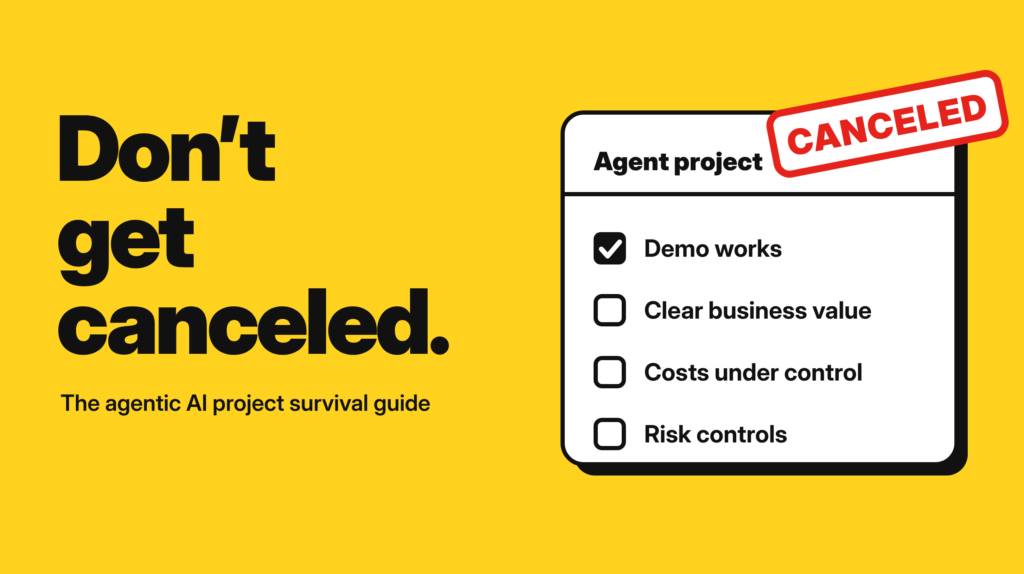
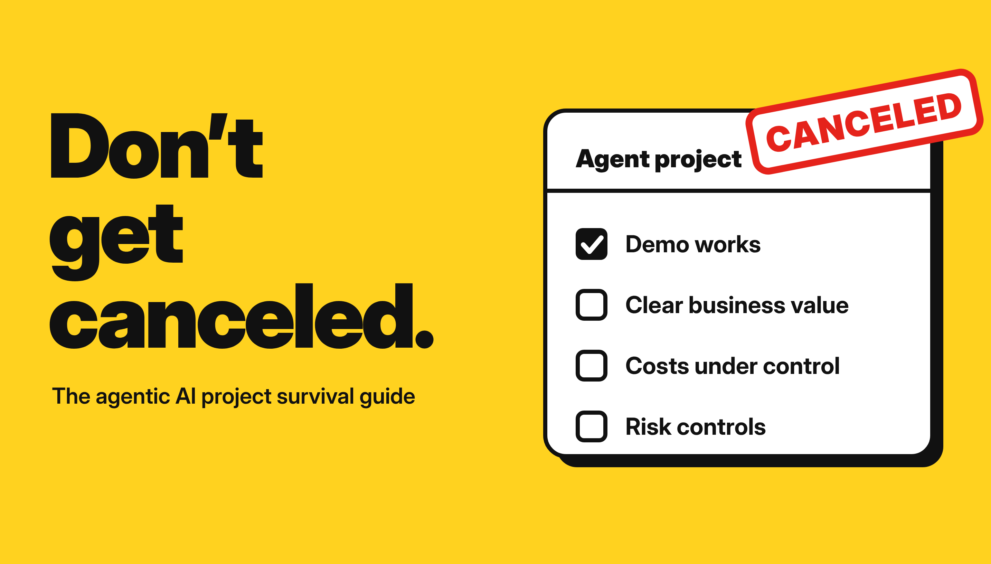
Gartner predicts that 40% of business applications will include task-specific AI agents by 2026, up from less than 5% in 2025. That same year, Gartner also predicted that more than 40% of agentic AI projects will be canceled by the end of 2027. The reasons it gave were rising costs, unclear business value, and weak risk controls.
Its analysts described most current projects as early experiments, driven by hype and often used in the wrong place. Their advice is simple: only pursue agentic AI where it delivers clear value or a measurable return.
What Is “Agent Washing”?
Many vendors now put an “AI agent” label on products that are really chatbots, basic AI assistants, or old robotic process automation (RPA) tools. Gartner calls this agent washing. It estimates that only about 130 of the thousands of vendors claiming agentic features offer the real thing.
This matters because if you can’t tell a true agent from a renamed chatbot, you can end up paying agent prices for chatbot results.
Five Reasons Projects Get Canceled
- The task didn’t need an agent. Some problems are solved by simple automation or a chatbot. An agent adds cost and complexity you don’t need.
- No starting number. If you don’t measure how long a task takes or what it costs today, you can’t prove the agent helped.
- A messy process underneath. Putting an agent on top of a confusing, undocumented workflow just automates the confusion.
- No human checkpoints. Without approvals on risky actions, one bad decision can wipe out trust, and the project gets shut down.
- Costs that grow quietly. Model usage, integrations, and upkeep add up. Teams that don’t track cost per task get surprised.
Do You Even Need an Agent?
Not every problem calls for one. Here’s a quick way to match the tool to the job:
| Situation | Best fit |
| The steps are fixed and rarely change | Simple automation or RPA |
| You need answers or drafts on demand | AI chatbot or assistant |
| The work has many steps, touches several systems, and needs some judgment | AI agent |
Before you start, ask yourself four questions:
- Does this task take real hours every week?
- Does it need judgment, not just fixed rules?
- Can I measure success with a number, like time saved or cost per ticket?
- Can a person review the risky steps?
If you answered no to the first two, an agent is probably overkill. If you answered yes to all four, you have a strong candidate.
How Agentic AI Development Services Reduce the Risk
Good agentic ai development services are built around the exact problems above. Here’s how a strong partner handles each one:
| Why projects fail | What a good partner does |
| Wrong use case | Scores your workflows and picks the best fit, even if that means recommending simple automation |
| No starting number | Measures time, cost, and error rates before building anything |
| Messy process | Maps and cleans up the workflow first |
| No human checkpoints | Adds approval steps, limited access, and activity logs |
| Hidden costs | Tracks cost per task and sets usage limits |
Five Questions to Spot Agent Washing Before You Sign
- Can you show the agent making multi-step decisions on a real workflow, not just a scripted demo?
- What happens when it gets something wrong?
- How do you measure accuracy, cost, and ROI?
- How do you handle security and compliance, such as SOC 2, HIPAA, or CCPA, and do you follow the NIST AI Risk Management Framework?
- Who owns the code and the data when the project ends?
A partner who answers clearly and shows real examples is a good sign. If all you hear is buzzwords, keep looking.
What a Low-Risk First Project Looks Like
Strong agentic AI development services start small and include a clear stop point. A typical first project follows this rhythm:
- Weeks 1 to 2, workflow review: pick one task and record what it costs today in time and money.
- Weeks 3 to 8, pilot: build a small agent with human approval on the important actions.
- Weeks 9 to 12, go or no-go: compare the results with your starting numbers, then scale it, adjust it, or stop.
That last step is what protects your budget. A good project can end early if the numbers don’t work, and that’s a better outcome than a quiet failure a year later
Want a Second Opinion Before You Build?
If you’re weighing an agent project, book a free workflow review with our team. We’ll look at one task, tell you honestly whether an agent is the right tool, and outline a simple first step. If simple automation is a better fit, we’ll say so.