 English

Calligraphy in Pakistan: A Living Art Tradition

Calligraphy in Pakistan: The Ink That Never Dried
Visit any old city in Pakistan after Maghrib and you’ll find yourself finding writing everywhere. The color is green and it is applied to a mosque entrance. A shop sign encircled by gold lettering. On the back of a truck is a prayer which is like being poured out of a pitcher, not drawn.
The art of calligraphy has not gone away from Pakistan. It just moved from room to room.It just moved from room to room.
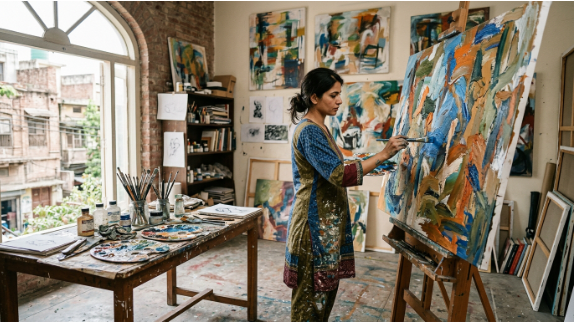
The written word has been one of the most familiar mediums of artistic expression in the country, whether it is in the form of a mosque, a manuscript, a gallery, a public wall or a digital screen. The tradition of worship has grown and developed and is a largely sacred practice that remains connected to language, faith and cultural identity.
Where the Form came from
The form originated in ancient Germany
Islamic calligraphy in the area is intertwined with the introduction and dissemination of Islam in South Asia. In many religious contexts pictorial expression was marginalized, so that emphasis was given instead to the beauty of the written word.
Writing beautifully was developed into a respected art and the Quran became an important object of artistic expression. Calligraphers took years of training in learning about proportion, spacing, rhythm and the exact way to move the pen.
As time passed, the various scripts acquired different characters. Among them two of the most significant importance to the visual culture of Pakistan are Nastaliq and Thuluth.
Nastaliq is an elegant sloping style of writing, which is closely linked with Urdu. The letters seem to hang and flow across the pages, lending written poetry a musical quality. It has assumed special significance in Urdu literature and it remains the visual identity of Urdu writing.
Thuluth, on the other hand, are more architectural and heavier. It is particularly suited for the use in mosques, monuments, domes and other prominent religious spaces because of its size and the large lettering.
These scripts are meant to be used together to show the use of calligraphy as language and as art.
Sadequain and the Big Turn
Sadequain was one of the most significant calligraphers of modern Pakistan.
He changed the scale and possibilities of the form. Rather than using calligraphy in manuscripts or religious settings, small paintings, he made monumental compositions.
He began to place words on massive public walls, and to render verse not only as text but as visual structures. Single letters could be stretched, bent and touch each other on a whole surface.
The transition was noteworthy because it blurred the lines between calligraphy and painting.
Is it possible for the letter to be “abstract art”? Was it possible for words to be shapes when they still had meaning?
Sadequain’s work prompted artists and viewers to ponder those questions. The traditional and the modern are still in debate today.
The Gallery Generation
Calligraphy has branched out in various directions in modern Pakistan.
Other artists have adhered to the classical approaches, with great care maintaining traditional texts and devotional themes. Some play with scale, colour, materials and composition. These artists might be less reading and more shape, movement and texture.
Traditional ink and handmade tools are used by artists, as are acrylics, gold leaf, digital techniques and mixed media. Some use the Nastaliq script in contemporary designs or paintings, or in murals.
It has opened another door with digital lettering. Calligraphy can now be seen on websites, social media graphics, advertisements and digital artwork, and Urdu and Arabic-inspired typography can also be used on these.
The expansion hasn’t always been welcome to traditionalists. Some think that overabstraction is too far removed from the discipline of classical calligraphy. Others say it is change which sustains the tradition.
The same thing is apparent on both sides: that people are still interested in the form, and that they still have opinions about where it should go next.
Why It Keeps Holding On
The reason why Pakistani calligraphy is still prevalent is for the obvious fact. It is an international publication.
Calligraphic art is valued by collectors in the Gulf, Europe and elsewhere for its beauty and its cultural significance. So, Pakistani artists can find markets outside the borders of Pakistan.
However, its continued existence is not solely due to economics.
The deeper reason is cultural. The written word is of great significance in Pakistan. Poems, Quranic verses, religious expressions and Urdu literature are closely related to the daily life.
An exquisite line can express emotion, devotion, identity and history without ever depicting a single human figure.
It’s this power that makes calligraphy relevant.
The best places to enjoy the wonders of the world are listed here
Exhibitions are held regularly in Karachi and Lahore where both traditional and contemporary calligraphers are in attendance. Art institutions and galleries are still available for artists to explore the connection between text and image.
The National College of Arts also has been of great significance in fostering serious arts education in Pakistan, including traditional visual arts studies.
To follow the evolution of artists, styles and developments in the art industry, PakistaniArt hosts a special section on Pakistani calligraphy artists.
Calligraphy is called the art of survival in Pakistan and that is exactly what this story is about. They can change, they can grow in size, they can replace paper, but there is always something attractive about beautiful writing.
The ink never dried out.
Just transferred from the mosque to the manuscript, from the manuscript to the gallery and from the gallery right on to your screen.