
 English


What Actually Decides the Price of a Microscope in India

What Actually Decides the Price of a Microscope in India
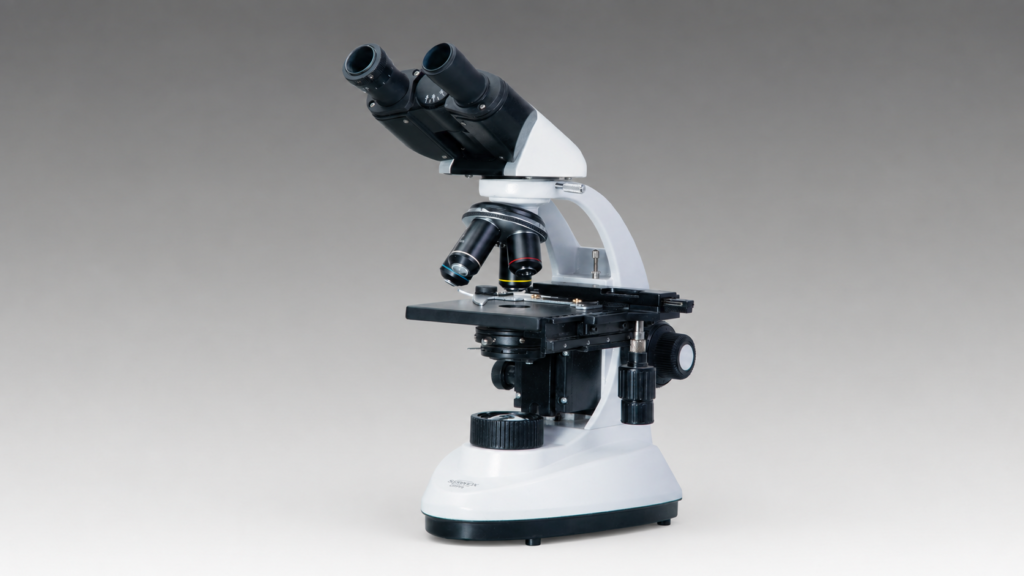
Two quotations land on the same desk. Same specification on paper — binocular head, 10x, 40x, 100x objectives, LED illumination. One is priced at roughly half the other.
Anyone who has sat on a purchase committee knows what happens next. Somebody asks why, nobody has a good answer, and the cheaper quote gets approved because there is no visible reason to spend more.
Two years later the answer arrives on its own.
The specification sheet is not the instrument
A microscope quotation lists what the instrument has. It does not describe how well any of it was made, and that gap is where most of the price difference sits.
Take the objectives. Two lenses can both be marked 40x and behave completely differently — one holds a sharp image across the field, the other goes soft towards the edges and drifts out of focus when the stage is nudged. Both are 40x. Only one is usable for an hour at a stretch.
The same applies to the mechanical parts. A stage that moves smoothly and stays where it is left costs more to make than one that does not. Focus mechanisms with no play in them cost more than focus mechanisms with play. None of this shows up in the technical column of a comparison table, and all of it shows up on the bench.
What genuinely moves the price
Optics come first. Achromatic objectives are the standard fit; semi-plan and plan objectives cost progressively more and give a flatter, sharper field, which starts to matter as soon as anyone photographs a slide or works long sessions.
The viewing head is next. Monocular is cheapest, binocular is far more comfortable, and trinocular adds a third port for a camera. Most labs that skip the trinocular head end up wanting it within three years.
Illumination follows. A simple LED costs little. Adjustable, evenly distributed illumination with proper condenser control costs more and makes a visible difference on stained slides.
Then certification. ISI marked instruments are made to the Bureau of Indian Standards specification and tested against it, and for most government purchases that mark is not a preference but an eligibility condition.
And finally the part that never appears in any quotation at all — whether the seller can still supply a spare objective or an illumination unit five years from now.
Manufacturer or trader?
This changes the price and it changes everything afterwards.
A trader buys finished instruments and resells them. If the source changes, the product changes, and support depends on whoever supplied them originally. A manufacturer builds the instrument, holds spares for its own models, and can modify a configuration when a lab needs something slightly different.
India has a genuine manufacturing base here — Ambala in Haryana has been producing scientific instruments for decades, and several long-established firms still build optics there rather than importing and relabelling. SUSWOX, for instance, has worked as a microscope manufacturer in India from Ambala since 1973, supplying AIIMS campuses, universities and government laboratories directly.
Buying from a manufacturer usually costs a little more at the quotation stage. It costs considerably less across the life of the instrument, which for a laboratory microscope is fifteen or twenty years.
The questions worth asking before approving a quote
Ask who made the instrument, not who is selling it. Ask whether the ISI mark applies to the exact model quoted. Ask how long spares stay available and who handles service — the seller or someone else.
Then ask for the instrument to be demonstrated with a real slide, not a brochure. Fifteen minutes at the eyepiece settles arguments that a comparison sheet cannot.
And ask what the price includes. Objectives, illumination, dust cover, warranty terms and installation are quoted differently by different sellers, and a cheap headline figure often has three of those missing.
If you want a reliable reference point on what the price of a microscope in India should cover at each level, ask a manufacturer for a written quotation rather than reading a marketplace listing. The two are rarely describing the same instrument.
Where cutting cost is fine
None of this means every lab should buy the most expensive option. Plenty of purchases are over-specified.
A school teaching senior biology does not need plan objectives or a trinocular head. A clinic doing routine work does not need research-grade illumination. Paying for capability that nobody in the building will use is as wasteful as buying an instrument that fails in year three, and it happens just as often — usually because someone was sold upward rather than advised.
The saving worth making is on features. The saving not worth making is on optics quality, mechanical build and support, because those three decide whether the instrument works at all.
The real cost is per year, not per unit
A microscope bought for a school or a diagnostic lab is not an annual purchase. It sits on a bench for a decade or more, and the sensible way to compare two quotations is to divide each by the years of service you expect from it.
By that arithmetic, a well-built instrument at a higher price is almost always the cheaper one. The expensive purchase is the one that gets replaced in year four because a lens cannot be sourced.
So when the two quotations do not match, do not assume one seller is being greedy. Find out what the difference is buying. Usually it is buying you the ten years after the warranty ends.